Since early civilisation the Donkey has helped carry the load of man . They are a very special animal and today they are celebrated .
I am involved with the Good Samaritan Donkey sanctuary in The Hunter Valley . Many of the donkeys , come to the sanctuary as rescues . Therefore in need of some treatment ,as some are lame . Animal Chiropractic treatments are of great benefit to their recovery . It can be very satisfying helping these lovely donkeys . Neil Gregory
These 3 exercises are termed ‘the Big 3’ by spinal researcher Dr Stuart Mcgill. The exercises are performed in a neutral back position – a spine sparing position and it helps to build muscular fitness along with stability and control throughout the spinal column. Spinal stability is what creates a strong core.
You do not have to be in pain to perform these exercises. These are actually best used as a preventative method to prevent back pain! Although if you are in pain, they are still a great way to help you get your core switching on again.
Some things to note:
· The exercises must be performed daily
· The best time is mid-morning or dinner time. Not upon waking – as this is when the spinal discs are at their fullest and therefore less room to move
· Reps and sets are important to what you can tolerate. There is no point trying to push through excruciating pain. Find your level and then progress
· Try and ensure that all 3 exercises are performed in a pain free posture for your spine.
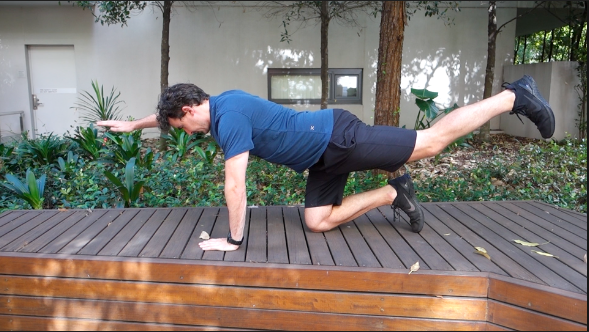
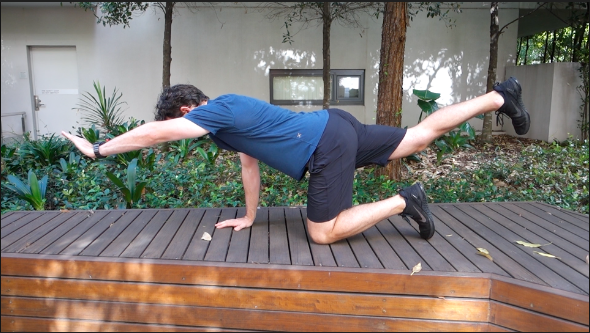
1. Bird dog
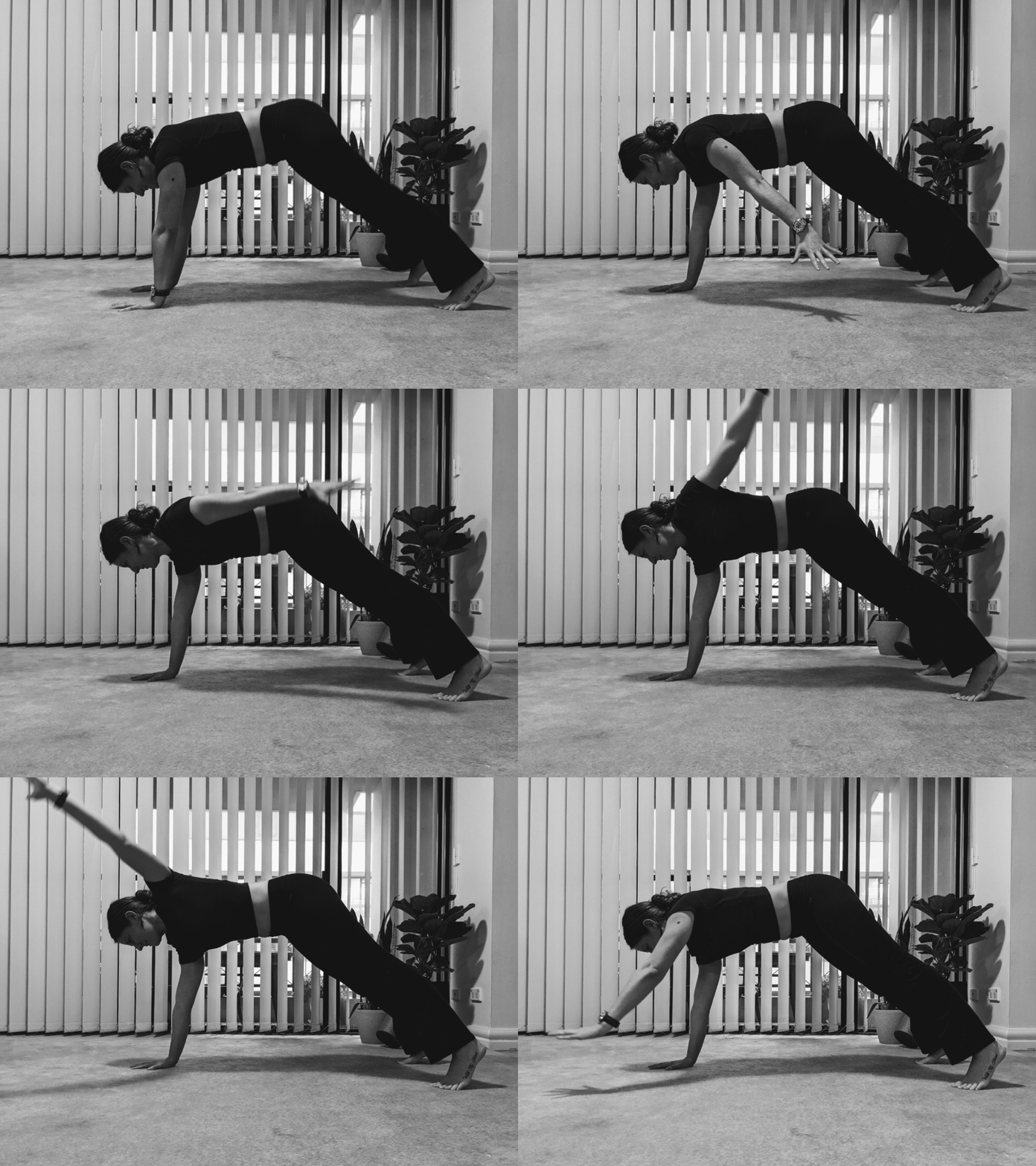
Position yourself on all fours. Raise your right hand forward while simultaneously extending your left leg back, until both are parallel. Bring both arm and leg back into the resting position and then repeat with the opposite arm and leg. This is one rep.
Make sure your pelvis has minimal rotation while performing this exercise. The value of this exercise is coordinating upper back, lower back and hip movement all together.
Perform 1 set of 8, followed by another set of 6, with a final set of 4.
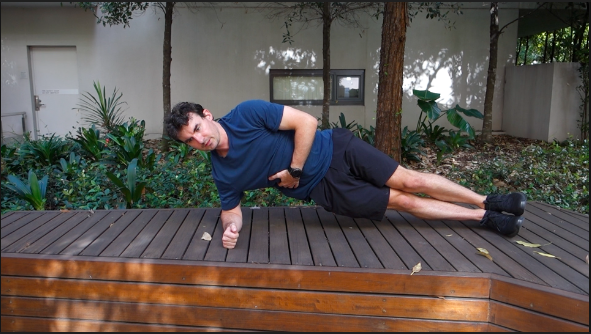
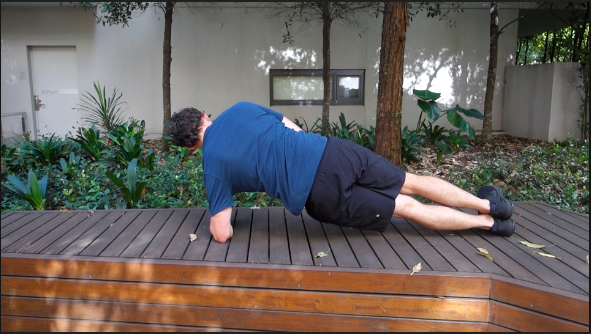
2. The side plank
Lie on your side, resting on your bent forearm, with your legs straight out
Lift your hips off the floor and hold for 10 seconds. You should feel your abdominal muscles and obliques (side) working. This exercise also works the quadratus lumborum (QL), a major spine muscle that plays a role in spine flexion and rotation. This exercise gets the QL and oblique muscles working together in coordination.
Perform 3-4 holds per side of 10 seconds each. Repeat for 3 sets, but with each set, reduce the reps by 1.
3. The curl up
The Mcgill curl up is not like your traditional curl up. There is no movement from lumbar spine.
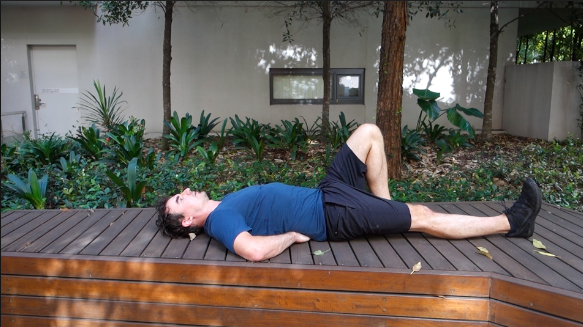
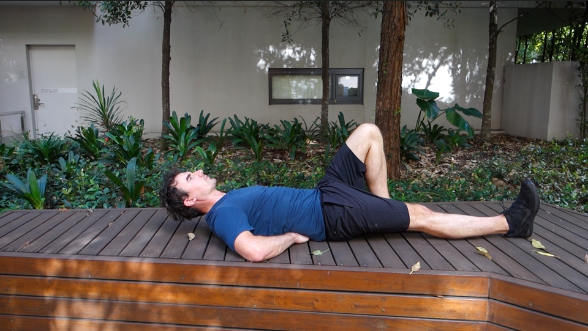
Start by lying on the ground, with 1 leg bent up and the other leg straight (the painful side should be the one with the straight leg). Place both hands under the small of your back, this will ensure minimal movement through the lower back.
Lift your head off the ground by a few inches and then hold it there for a count of 10. The goal is to perform this without any movement in the lower back. If you feel your lower back rounding, then your head or shoulders are too high off the ground.
During this, you should feel your abdominal muscles brace – this is the spinal stability
Repeat another 5 times for a total of 6 reps. The recommended volume is 1 set of 6, followed by another set of 4 and the final set of 2. You do not need to hold the curl up for more than 10 seconds, rather to progress you can increase the reps.
Conclusion
I recommend using these exercises every day as the best preventive measure to avoid lower back pain. If you do have back pain, they are also great to perform as they can be done in a pain free position. The key is being consistent, once a day and before any exercise.
Archies arch support slides are now in stock at Mona Vale Chiropractic Centre. The new range compliments Archies arch support thongs. We have an extensive range of colours and sizes. Once you try Archies, you will never wear anything else. Highly recommended by your local Chiropractors. Call in to try them to find the perfect fit or phone us on 9997-5773 to order
Everytime you refer a friend (including family members) before June 30th 2023, you will receive a $40 credit to your account. This can be used for any treatments or products at Mona Vale Chiropractic Centre.
The terms ‘stretching’ and ‘warmup’ are often used interchangeably, however they are not necessarily the same thing. Stretching and warming up both serve their own purpose in any exercise regime. In my previous blog, I highlighted the importance of stretching and clarified that stretching should be done after exercise and physical activity. Before exercise, mobilising the joints and performing a dynamic warm up is where you should start.
When in doubt just remember MES:
According to former NSW State of Origin player David Williams:
“Warming up the muscles and mobilising your joints before any strenuous physical activity or exercise, is vital for the body to move through its full range efficiently and effectively whilst greatly lowering the risk of injury.”
David Williams aka Wolfman
Click image for animation
Dynamic Warmup
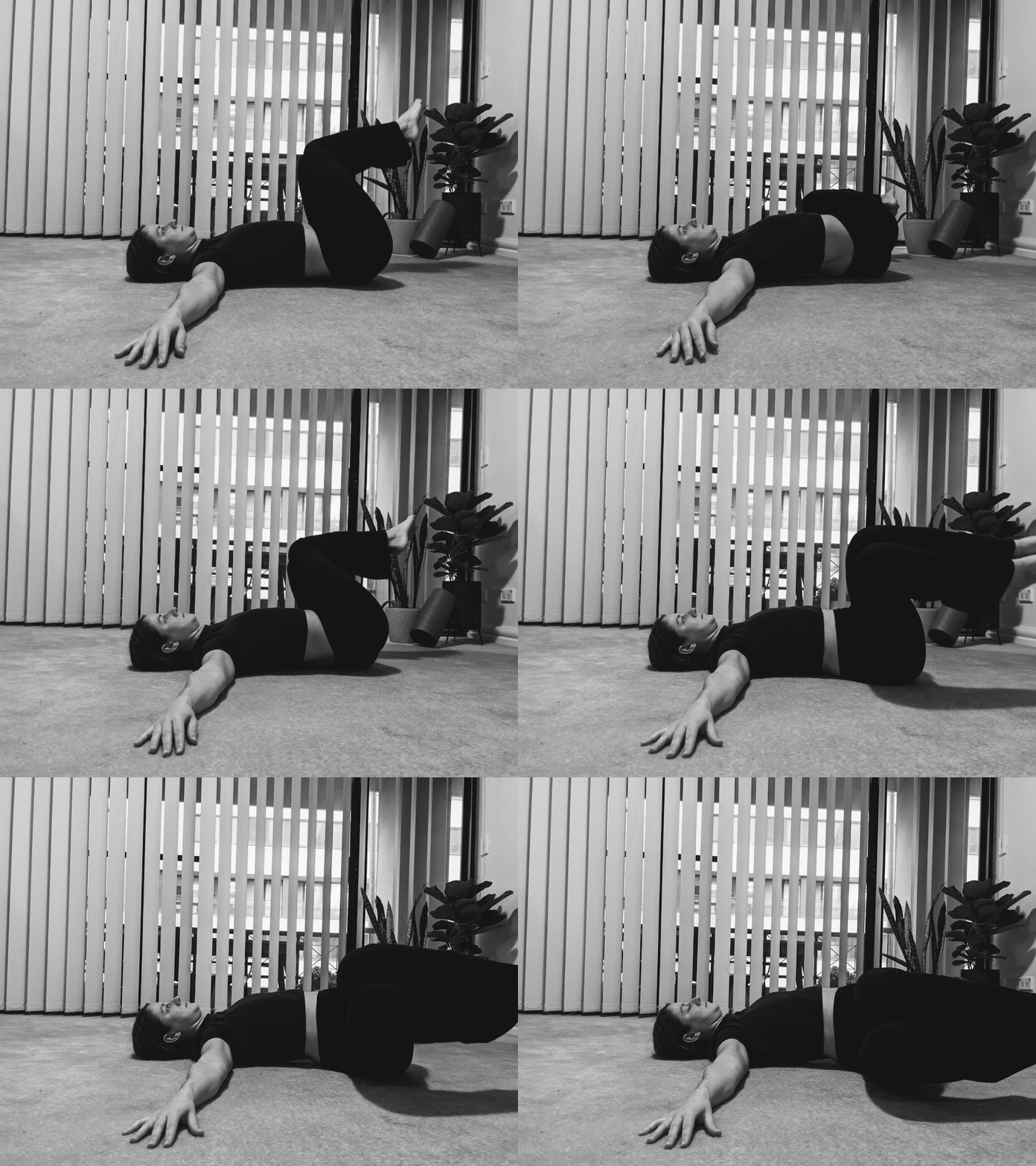
A mobilisation technique or ‘dynamic warmup’ involves easing your joints into full range of motion. This prepares the muscles for movement and wakes up the body’s nervous system. By mimicking movements that you are about to perform in your work out, you are gradually increasing flexibility and blood flow to the areas that will be moving in your sport or activity.
Focus on major muscle groups and the muscles used most in your activity. For example, if you are about to go for a run, you should focus on mobilising your hips, knees, and ankles. If you are a swimmer, you should mobilise your upper back, neck, and shoulders.
Click image for animation
Things to Remember
When doing a dynamic warm up, remember to focus on symmetry. Always do equal amounts of movement on both sides of the body.
Start at a low level of movement and then slowly increase intensity until your joints and muscles feel ready to go.
Remember that some joints will have more range of motion than others. Injuries, ageing, and even genes can restrict some of our joints, so don’t try and force a joint past its natural range.
Sources
Williams, D., 2021. Performance Coach [Interview] (28th June 2021).
Taylor, K.-L., Sheppard, J. M., Lee, H. & Plummer, N., 2009. Negative effect of static stretching restored when combined with a sport specific warm-up component. Journal of Science and Medicine in Sport, 12(6), pp. 657-661.
“Should I stretch before or after I exercise? Or both?”
This is a frequent question asked by my clients when we are talking about movement and exercise.
My job as a massage therapist is to assist my clients with sore muscles, sports injuries, and stress management. Regardless of what ailment a client presents with, we always discuss what they are doing for daily exercise. In this day and age, we all know that habitual exercise is crucial for our health and well being. Reasons to be physically active everyday include:
Feeling more energized
Burning more calories when at rest
Improving overall appearance
Ability to withstand stress
Improved sleep
Speed up recovery from injury or surgery
Decrease the risk of illness and injury
Keeping focused
Building up cardiovascular endurance
Improving flexibility and range of motion
The ability to perform daily exercise, requires our joints to be healthy enough to cope with consistent movement. Maintaining our flexibility, joint range of motion, and joint health comes down to the wonderful combination of exercise and stretching. Stretching our muscles has been proven to:
Improve your joint range of motion
Maintain joint health
Improve athletic performance
Decrease risk of injury (1)
Now that we have a better understanding of why stretching and daily exercise are so important, when should we stretch?
Stretching should not be considered a warmup. By stretching cold muscles, you increase the risk of injuring yourself. Instead, consider performing mobilisation techniques, which I will cover in my next blog. Stretch after your workout when your muscles are warm. Remember to focus on the main muscle groups that were used during your workout session. (2)
Research shows that stretching before a workout does not reduce muscle soreness in the days after. Other results show that lengthening the muscle and holding the stretch immediately before a sprint may slightly worsen performance. Consider skipping stretching before any intense activity, such as sprinting or track and field activities. Pre-event stretching may decrease performance and create weakness in the hamstring strength. (3)
Gentle stretching at the end of any exercise also gives you a great chance to catch your breath, be still, and reflect on the hard work you just achieved!
June 20th 2021
By: Sydney LaVine
Sources
Harvard Health. (2019, August 26). Retrieved from Harvard Health Publishing: https://www.health.harvard.edu/newsletter_article/why-we-should-exercise-and-why-we-dont
2. Stretching is not a warm up! Find out why. (n.d.). Retrieved 6 19, 2021, from https://www.mayoclinic.org/healthy-lifestyle/fitness/in-depth/stretching/art-20047931
3. Taylor, K.-L., Sheppard, J. M., Lee, H., & Plummer, N. (2009). Negative effect of static stretching restored when combined with a sport specific warm-up component. Journal of Science and Medicine in Sport, 12(6), 657-661. Retrieved 6 19, 2021, from https://sciencedirect.com/science/article/pii/s1440244008000790
Keeping our immune system strong helps us stay well in times of stress. This includes rest with adequate sleep, regular exercise, drinking water and eating well and regularly. There are times in our lives where our stress levels are very high. We should all be aware that with the current Covid19 crisis we are all experiencing extreme anxiety and stress. We are functioning at heightened levels that as a family, community and country we have never experienced before. This will put pressure on our immune system. Vitamin C and Vitamin D are good supplements to take to help our bodies in such times. Vitamin C is found in some very familiar foods including Broccoli, Cauliflower, Kale, Kiwi-Fruit, Citrus Fruits, Pineapples, Strawberries, Cranberries, Blueberries and Watermelon. Vitamin C benefits our bodies in growth and repair. It aids in absorption of iron, the healing of wounds, the maintenance of cartilage, bones and teeth. Vitamin C also boosts our immunity. Vitamin D, commonly known to be sourced by sunlight, is important in our bodies regulation and ability to absorb calcium. It is also important for the maintenance of phosphorus levels in our blood. Vitamin D deficiency is associated with an increased susceptibility to infection. We need both Vitamin C and Vitamin D daily, ideally in small to moderate levels regularly. Because our immune system defends our body from foreign organisms, promoting and boosting a healthy immunity helps to keep us well. This is essential in these times of heightened stress.
It has long been thought that the constant pounding of running can cause degeneration of the lumbar disc, however this theory has recently been debunked. A 2017 study from Deakin University in Victoria has found that people who regularly run or walk have stronger and healthier discs in their spine compared to people who do not exercise.
It was shown that through running or brisk walking, the disc showed improved hydration, increased protein content and growth of the disc. The control group for the study were sedentary, non-active adults – whom showed no change in disc characteristics.
One important factor from this study is that the brisk walking and running groups both showed the same amount of improvement in disc health. So, you don’t have to be a runner to improve the health of your discs, walking is fine as well!
The authors concluded that the response of the disc to running is very similar to the response of muscle in resistance training.
What if I have a disc injury?
If you have a disc injury, movement is good for it! It allows the disc to recover through getting nutrition to the disc to allow for repair. If minimal movement occurs at the disc, healing will be therefore very slow.
Why is this so?
Discs get their nutrition through diffusion from the bony endplate of the vertebra above and below. The way this diffusion works is through movement. The constant loading and unloading of the spine through walking or running allows for the flow of nutrients to the disc. In sedentary individuals, the diffusion of nutrients is poor due to the lack of movement, hence why degeneration and dehydration of the discs is more likely.
So the take home message is to move more to strengthen and improve your back health. It also doesn’t have to be intense running, a brisk walk is also as beneficial. Walking with a disc injury is also an important part of the recovery, as it allows for the disc to receive nutrients to allow for repair to occur.
Belavy, D. L. et al. Running exercise strenghtens the intervertebral disc. Sci. Rep. 7, 45975; doi:10.1038/srep45975 (2017)