
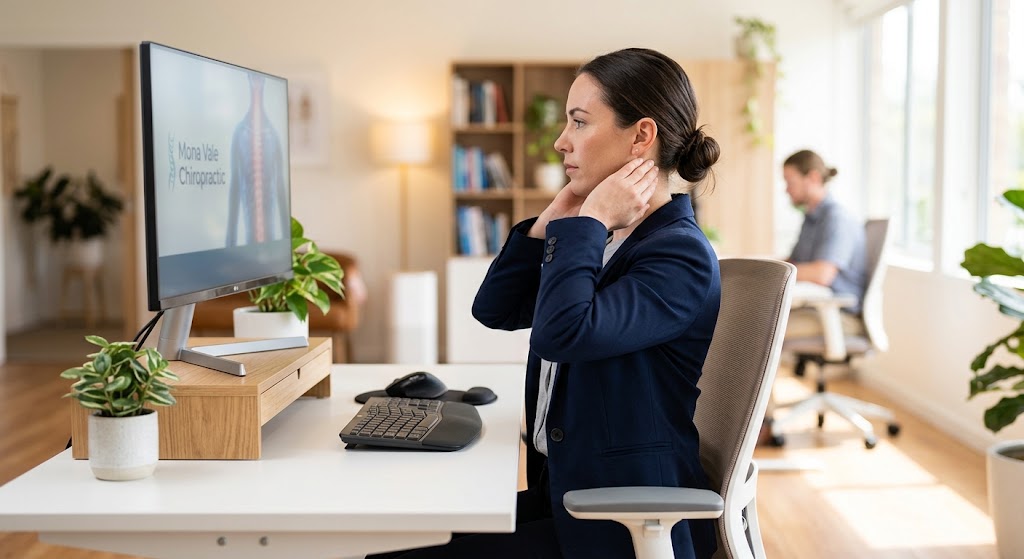
In a modern work environment, spending hours hunched over a laptop, smartphone, or dual-monitor setup has become the default. While technology keeps us productive, our bodies often pay the toll.
If you find yourself rubbing your upper shoulders by mid-afternoon, experiencing a dull ache at the base of your skull, or feeling stiff every time you turn your head, you are likely dealing with what is commonly referred to as “tech neck.”
Understanding why this happens—and knowing how to break the cycle with simple, evidence-based movement—can make a significant difference in how you feel at the end of the workday.
Understanding Cervical Strain
The human head is remarkably heavy, typically weighing between 4.5 to 5.5 kilograms in a neutral, upright position. However, biomechanics change dramatically as the head shifts forward.
When you slouch or jut your chin forward to peer at a screen, the effective load placed on your cervical spine and supporting upper back muscles increases exponentially.
Over hours of sustained static posture, the muscles at the back of your neck and upper shoulders (such as your upper trapezius and suboccipitals) must work overtime to prevent your head from dropping further. Simultaneously, the deep cervical flexors in the front become stretched and under-active.
This sustained imbalance leads to local muscle fatigue, tissue irritation, and a familiar, persistent ache across the upper back and neck.
3 Desk-Friendly Exercises to Reset Your Neck
You do not need an hour-long break or specialized equipment to combat this midday stiffness. Try incorporating these three simple movements into your daily routine to restore mobility and relieve tension:
1. The Seated Chin Tuck (Axial Extension)
- Why it helps: This exercise targets the deep cervical flexors at the front of the neck while gently lengthening the overactive muscles at the base of the skull.
- How to do it: Sit tall at the edge of your desk with your shoulders relaxed. Looking straight ahead, gently draw your chin straight back—as if making a “double chin”—without tilting your head up or down. Hold the position for 3 to 5 seconds while breathing smoothly, then release. Repeat for 8 to 10 repetitions.
2. Seated Thoracic Extension over the Chair Back
- Why it helps: Neck strain is frequently driven by stiffness in the mid-back (the thoracic spine). When your mid-back refuses to extend, your neck has to work harder to look up or keep your gaze level.
- How to do it: Sit back in a chair that has a backrest ending around your mid-back blades. Interlace your fingers and place your hands gently behind the back of your head. Lean your upper back backward over the top of the chair rest, gently looking up toward the ceiling. Return to the starting position and repeat 5 to 8 times to open up the chest and mid-spine.
3. Scapular Retractions with External Rotation
- Why it helps: Pulling your shoulder blades back helps counteract the rounded-shoulder posture that pulls your entire upper quarter forward.
- How to do it: Sit or stand tall with your arms by your sides, elbows bent at 90 degrees. Squeeze your shoulder blades back and together, while gently rotating your forearms outward (palms opening up). Hold for 2 seconds, feeling the muscles between your shoulder blades engage, then release. Perform 10 to 12 controlled repetitions.
When to Seek Professional Support
While regular movement, proper desk ergonomics, and targeted stretches go a long way in managing daily fatigue, persistent or worsening discomfort requires a proper clinical assessment.
If your neck tension is accompanied by sharp, radiating pain down your arm, numbness, tingling in your fingers, or frequent tension headaches that do not respond to basic self-care, it is time to get it checked.
A thorough examination can help identify the root cause of your symptoms, rule out more complex spinal issues, and provide targeted hands-on care—such as joint mobilisation, soft tissue release, and personalised active rehabilitation—to help you move and feel better.
Are you struggling to shake persistent desk-related stiffness? Book a consultation with us for a comprehensive assessment and a tailored management plan to keep you moving comfortably.